Thursday, 30 January 2014

Don't pick your scab.

Don't pick your scab. 

Some of the best advice that I was given when growing up. If you pick your scab it won't heal very well, it will bleed again, it will get infected. I once was running home from a friends house wearing my ballet shoes (I never did ballet - I've never been dainty enough or had the coordination - but I had ballet shoes) and I fell over. I seem to remember I was carrying roller skates. Why I was wearing ballet shoes with roller skates anyway I have no idea and am surprised I didn't fall over earlier. Anyway, I fell over and my knee did that thing - it bled everywhere. I got an amazing scab. 

A little while later (days? weeks?) I was at a Girls Brigade party and the scab that I had evidently been picking was knocked off in a game. My knee started to bleed again and as a result I have now on my right knee a white mark where it never had chance to heal properly. 

Don't pick your scab. 


As we journey through life we pick up wounds - some of them heal completely, some of them scab over. The trouble is that the ones that simply scab over get picked at at random intervals and they begin to bleed again. They stop us in our tracks as we realise that once again we need to clean up the mess and put a plaster on and wait for them to scab over again trying to get to the point where we stop picking so they heal completely - so that the scar is all that remains. 

Don't pick your scab.

I've noticed in being part of a church community that people have their favourite scabs to pick at - it starts with the choice of biscuit, the choice of hymns, the way things are done, the steps we are taking forward, our particular view of theology, our deep held beliefs that we are reluctant to challenge, our theological bugbear...... some of these things needed to be removed completely, some simply healed over, some actually left to flourish - but the problem we have is that we keep picking at them because it feels familiar and quite nice to pick a scab and make it bleed again so we don't have to look forward to the next hill we need to run up (or down) to get to the next place that God is taking us. 

Don't pick your scab.


I've been involved a lot in discussions about the future lately - as part of the wider Baptist family, as a Methodist circuit, as a college, as a church and as just me and one thing that has struck me is that however big the decisions that we are making we all have those scabs that at the right moment we pick at, make bleed and stop us in our tracks. 

I've decided in the last few months that I'm going to stop picking at mine. I'm also going to try and stop other people trying to pick at mine too (although that is a little bit harder). If less people picked at their own and others scabs the journey would become so much less messy (or different kind of messy) and we might actually get somewhere. 

Don't pick your scab. Just stop it..... stop.... it.....  

"I’m not saying that I have this all together, that I have it made. But I am well on my way, reaching out for Christ, who has so wondrously reached out for me. Friends, don’t get me wrong: By no means do I count myself an expert in all of this, but I’ve got my eye on the goal, where God is beckoning us onward—to Jesus. I’m off and running, and I’m not turning back."              Philippians 3:12-14 (MSG)


Monday, 13 January 2014

Keeping the riff raff out....


I got the box set of Gavin and Stacey for Christmas and have watched it all this weekend (there is something quite exciting about watching a series from start to finish in a very short period of time). As well as realising that there were episodes I hadn't actually seen (my suspicions were correct - I got to the series late and have only watched it when I have spotted a repeat) it also got me thinking.... 

In the episode where Nessa has gone into labour and Smithy rushes from Essex to Wales to be there for the birth, when he gets to the bridge him and Gav realise they are 10p short for the toll.... much arguing with the woman on the barrier goes on, and eventually Smithy gets out, lifts the barrier and they drive off. 

That barrier represents the distance between Gavin and Stacey - the difficulty in being together when they come from different places and have a different way of life. Gavin loves his home in Essex and Stacey loves her home in Wales. The barrier is symbolic of their differences, yet as these stories go, love conquers all and the barriers are overcome. 

Barriers are placed to keep people out or sometimes keep people in...! They are a way of life, making us pay money, keeping the riff raff out, perhaps protecting us from harm. 

As well as the physical barriers we also set up our own barriers to protect us from harm, to keep the riff raff out, to stop potential problems from happening. When we are feeling particularly vulnerable we put up barriers that don't need to be there. It means we don't have to encounter those things that we find difficult. It helps us to avoid a situation but doesn't help us deal with a situation. 

Some of us live in our own little fortresses. We cut off contact from those situations we find difficult, where to face things head on it will shake our very foundations. We cling to what we know - to structures and ways of doing stuff - so hard that we create barriers that won't let anyone else in. 

The trouble is, where we don't let anyone else in, or we create our own bubble of security, we miss the beauty of life. We miss the chance to interact with new people and ideas. We miss loving and getting to know the people who could make a great difference in our life. We put up our fortress and exclude and hurt those who we do not let in, those who we leave out in the cold. 

Psalm 62:6 says, 'Truly he [God] is my rock and my salvation; he is my fortress, I will not be shaken'.

When we create our own little fortresses of exclusion, keeping us and the ones we care about most 'safe', and keeping the riff raff out, we forget that God is our fortress. We don't need to create strong barriers, but need to acknowledge that God is the one that is the strongest fortress. Human made barriers prevent and stop, God's fortress enables us to move forward in his strength, which is stronger than any foundation that we might build in our own little fortresses. God's fortress is enabling and life changing, we need no other. 

Saturday, 28 December 2013

And everyone else....


One of the challenges of new year is more often or not the question of 'what shall I do on new years eve?' I try not to think about this question too early as it preoccupies me and I worry I'd make the wrong choice. The answer to this question has led me to a variety of different new year things with different people. I think the last time I didn't enjoy new year was when I had a horrible headache and went to bed at 10 missing celebrating the new year with my then boyfriend and his parents. 

This year I thought about spending new year on my own - just to see if it was ok. I thought about watching my new Miranda DVDs and possibly being really counter cultural and going to bed early. I'm not though, as it feels right to be with people at new year and I am spending it with people who I love a lot.  

One of the best things about the time around Christmas and New Year is time people take to just be with people. For me it is my family who have unspoken traditions of gathering for boxing day tea and going for a walk in the worst weather possible (this year we did it on the day of the storms - amber weather warning - let's walk). Community is important, yet as a single person I am very aware of how easy it is for people to get left isolated where everyone else around you is doing what they want to do. To do what I want to do I sometimes feel like I am invading the space of others. 

Today I read a newly released book I saw on Twitter called 'Cancer and Theology' edited by Jake Bouma and Erik Ullestad. It's a collection of essays exploring what Christian faith has to say about cancer. It struck me in reading it how important community is. For a number of the writers what was important in their experiences and in the experiences of those around them was the community of people who stood with them. Those who didn't just walk away and offer to pray, but asked them what they needed prayer for. Those who didn't just offer to help, but turned up with hot food at the right time. Those who didn't just want to sympathise but who wanted to talk about normal stuff too. Those who didn't say it'll be ok, but acknowledged that cancer is rubbish and sat through the rubbishness with them. 

Life changes, illness, being different and looked over can isolate us from community. Our fear of 'the other' means we sometimes unthinkingly isolate those who need to be welcomed. Our fear of being annoying or rejected means we isolate ourselves from being welcomed. We can't fix everyones problems by making them like us but we can stand with them on their journey and also seek out others to ride the waves with us. 

The challenge is to seek out community and not walk away from those who can stand with us. The challenge is to face the fact we might not always get it right, but accept one another even when we don't. The challenge is that people are sometimes weird and difficult - but that's ok. The challenge is to look, listen and simply be. The challenge is to fully embrace the idea that every person within a community is made in the image of God.

Thursday, 31 October 2013

Coming down from the top of the mountain


Last week I climbed up Helvellyn in the Lake District - it's the third highest mountain in England. We went up the steep way, because striding edge is a bit scary and because the steep way is shorter. I haven't climbed a mountain the last few years of being in the Lake District for our annual autumn holiday because I haven't felt fit enough. This year I was fit enough (mainly due to strange dance exercise classes) and was able to climb..... at my own pace... but climb. 

I got to the top and I felt my left knee do that thing where it doesn't want to bend any more.... where it doesn't want to play ball and work in the way it normally does. As we put our coats on as the clouds descended on the top I wondered whether it was going to last on the way down.... and it didn't. The descent was painful, mostly sidewards and accompanied at every step with loud shouts of 'ow' as my knee complained. I even got strange looks from the woman who had stopped near the bottom as her companions went up who said to me 'that's why I haven't gone any further'. 

I'm glad I did go further. I am glad I did get to the top.... but the descent made me question whether it was worth it. With hindsight it is and next year I am going to try and train my knees up to deal with mountain climbing, perhaps buy myself a couple of sticks and maybe try a different mountain. 

When you are at the top of the mountain it is awesome. You can see for miles. You feel like you've achieved something. But, at some point you need to get down as you wouldn't be able to survive up there for a very long time despite the awesome views. 

I'm now over half way through my ministerial training (can you believe it?) and it hit me a few months ago that the feeling of elation and excitement at doing what I am meant to be doing had gone away... that I was beginning to have to face the gritty reality of what this life can be like. I needed to begin to slowly descend that mountain where everything was awesome (I am sure I annoyed everyone by telling them how brilliant it was) to a place of balance where I can survive long term. 

The trouble is, on that descent, the knee problem sets in. It starts with a niggle, a moment of oh this could be difficult and then at times makes you cry out in pain. As you hit the reality of life in the descent there are times of blessing but there are also times of wrestling where you ask 'can I still do this?'. 

When you read testimonies of people in different forms of church leadership and ministry, one that stays at the summit of the mountain sounds glorious, but is it truthful? I've read honest accounts of real wrestling with God from people like Pete Grieg (God on Mute is a brilliant book) and heard stories of and seen people who behind the public face struggle with stress and depression. 

The reality is fantastically awesome on the mountain top (which is why I want to climb another one) but is painfully difficult when you are walking sidewards down a seemingly endless path of rocks.  

I was reminded yesterday of the poem 'If' by Rudyard Kipling where it talks about how if you can keep everything together when everyone else is not that that is the thing to aim for. It talks of being strong in adversity, of not being overcome by weakness. As I thought about it, I couldn't help but question that Kipling got it wrong. I think that a lot of people might see the role of the minister as being that person who holds it together - and perhaps there are times when that is true and only right. But.... 

2 Corinthians 2:19 says: "My grace is all you need, for my power is greatest when you are weak"

Being strong isn't all it's cracked up to be. Admitting you need God is. When we are at our weakest then God's power is at it's greatest. At the moment I can't expand on that further, but as I am descending the mountain and embracing the reality of ministry I need to admit that my knees hurt, and I need to remember that God is beside me, knees hurting too. 

"For I am the Lord your God who takes hold of your right hand and says to you. Do not fear; I will help you."                      Isaiah 41:13 

Tuesday, 15 October 2013

Busy, Busy, STOP, Busy.....?


I love my diary. I don't go for the cheap one because it's... well..... cheap any more. I have a moleskin diary. It flops nicely when you open it, it feels nice and it smells good. It has a page for the dates and a page for notes. I love it when it looks full - when each day has something written on it - when I look like I know what I am doing perhaps. 

However, I know that the better weeks are the weeks when I don't have something written down in my diary - when it doesn't look full.... not because I have nothing to do, but it is a sign that I am getting it right... that I am not busy. Busyness is a badge that we are happy to wear - it's become the norm to be busy, to have to consult our diaries, to only be able to book people in 3 months in advance to visit (or wait until last minute just in case something better comes up). We become addicted to doing one thing after the other with no down time - no time just to be..... no time to be with God. 

The problem with busyness is that it distorts our perception on things, it makes us feel self important (I'm too busy for anyone else), it makes you rude, it's an excuse for impatience, it's an excuse for not getting stuff done, it's addictive (you have to keep yourself busy otherwise what else would you do?), it burns you out and it's just lazy (there is no time to think about prioritising what is important if you do everything). And.... it pushes out the things that really matter.... like time with God. 

On Sunday we looked in the service at Mark 1:29-39. Jesus is busy busy busy, being pulled in all directions and as soon as he can he stops........ and he spends time with God..... however much it inconveniences others, however many pressing matters are in hand.... he stops. 

At the first opportunity he has, even at an unearthly hour.... Jesus goes to talk to his Father.... he prioritises space to pray. He knows that he must rely on God for his strength to keep going in a life that his unavoidably busy - otherwise he could get caught up in the moment. Withdrawing to pray is vital. Prayer is recognising that we aren't independent - that we can't do it all ourselves. 

The problem is that when you are busy you can know all there is to know about prayer, but you don't practice it. It's like being knowledgeable about a sport but never seeing it, never playing it. But... when we take time to pray we walk to the rhythm of God's heartbeat. 

Even the saviour of the world needs quiet time, alone... with God. 

I've been challenged in the last couple of weeks about what is important... this story right near the beginning of Jesus ministry shows what is important. I shouldn't have to make time to pray as interacting with God should be integral to my life. Everything else needs time made for it but time with God should always be there. It's OK if stuff falls off the list, it's OK to say no.....  but in prayer we learn how to walk to the rhythm of God's heart beat.... and that is transforming, enabling, and so much more......

"Do you not know? Have you not heard? The Lord is the everlasting God, the Creator of the ends of the earth. He will not grow tired or weary, and his understanding no-one can fathom. He gives strength to the weary and increases the power of the weak. Even youths grow tired and weary, and young men stumble and fall; but those who hope in the Lord will renew their strength. They will soar on wings like eagles; they will run and not grow weary, they will walk and not be faint".      Isaiah 40:28-31


Monday, 30 September 2013

Taking time over the journey......


When I was learning to teach I quickly learned the art of the three part lesson. Starter, teaching and practising, plenary. Starter gets your brain going, then you do the deep stuff (maths is well deep), then you sum it up. I always felt a bit of a bad teacher when these three parts didn't quite link together. For me the forming of a lesson was a bit of an art form - the flow from one part of the lesson to another meant that the pupils needed to be taken on a journey - whether they liked it or not. 

Sometimes my lessons would not fit nicely into a block of an hour and the three parts would be extended over a series of lessons. These were lessons that generally involved some kind of project - that dreaded group work that I inflict on others but find difficult myself. In these lessons I would be the facilitator and not the teacher, I'd guide and answer the questions, but the learning and teaching would be done by the pupils themselves. These lessons were at their best when I could leave them to it and dream..... Again though, these lessons took the pupils on a journey where from the same base thinking they came up with something beautiful and often very creative, taking the mathematical journey to different stages and arriving at different places. These were the lessons I tended to enjoy most as I watched the learning unfolding before my eyes. 

I've brought a lot of my experience from teaching into ministry. Only a couple of times have I had people say that I sound a bit like a teacher - perhaps when I am getting people to be quiet or when I get people to write stuff down. One of the things that I often have said to me, particularly after a worship service, is 'you put a lot into that' - mostly not in a bad way (like information overload) but in a 'you put a lot of effort into that' kind of way.

I've just finished reading 'The Art of Curating Worship' by Mark Pierson. I wrote a post about it a while ago (it takes me a long time to read any kind of Christian book I'm not reading for college or in preparation for something). What attracted me to this book was the idea of worship leader as curator - it resonated with what I saw as my role in the classroom as more of a facilitator whenever it was possible. Pierson talks of the planning that goes into any worship event, the journey that people are taken on and how the aims of the service should not only be reflected in the preachy bit but throughout the whole event.... and for me.... this feels right. 

So this is why when I am thinking about and planning worship I become absorbed in the event throughout the whole of the week preceding, why it might appear that I put a lot into it (most of the time the ideas are formed when I am doing other stuff, it's just gathering it together). I try and put as much thought into the whole journey (which should continue after the blessing has been said) as I do the sermon. Pierson suggests that planning an act of worship needs to take serious thought and time.... when balancing life sometimes it's difficult to do that... but to honour God, perhaps that time needs to be taken..... the effort is most definitely worth it. 

Interestingly Pierson also says that number 37 of his list of things the church he is part of must be and do is 'party well'. I like that. We should have more parties as church, it's part of our journey of knowing and loving one another (and I love good parties, they are excellent fun). 

Tuesday, 17 September 2013

People are weird

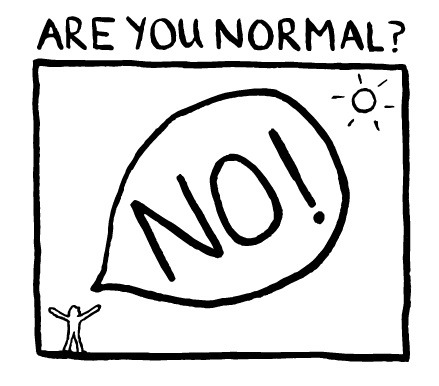
People are weird. This is my favourite sentence at the moment. It's true. You engage in conversation or you spend time with other people and you quickly come to the conclusion that people are weird. Not in a bad way (most of the time) but in a confusing way, a way that is difficult to understand, a way that means that you need to begin thinking slightly differently to try and understand where other people are coming from. 

I read a quote on facebook yesterday (thanks to one of my dreaming college friends who did this - I've been quoting it to everyone) .... here it is.....

"You are a creative soul. God never intended for you to be “normal”. Your emotions fluctuate because you feel more than people understand. You’re responsible to be prophetic in your art. Don’t sell out. Stop trying to be normal. Avoid the expected. Don’t deliver what is anticipated. Be willing to do some things that may fail. And, in all of this, you will find who God created you to be: a unique, beautiful – sometimes misunderstood – voice of his hope and love to this world." Stephen Brewster

I have no idea where this quote is from... but I love it. I love the use of the word 'normal'. As an occasional statistician, the word normal reminds me of a bell shaped distribution where 95% of people are within 2 standard deviations of the mean of whatever you're testing - these people would be normal - the more we try and be closer to that mean, the bell shape kind of stretches and squeezes, but there will always be 5% of people who are abnormal. We move the boundaries and different people become weird.....

As an occasional non-statistician normality appears to be what we strive for.... whether normality is fitting in with what is expected, doing what people want, walking on the pavement and not the road (if you have ever walked anywhere with me you will know I generally don't do that), buying a house, having a stable job etc etc 

That sounds a bit boring to me...... 

I love the fact that I live in a quirky town where the only train is a steam train and where half way down my road is a field with three sheep living in it. Most of the time I love the fact that in my working life every day is different because I work with people, and with people you never know what to expect. People are unpredictable. Predictability is that job where I did the same thing every day (like when I became an expert photocopier) and where every house looks the same (it's close on my road, but the sheep make it that little bit different). 

God never intended me to be normal. If you want the same thing all the time then I'm not your person. Level headed though I am (most of the time) I can be slightly erratic, off the cuff and frankly a little bit weird. I collect names for my family tree and do maths for fun. I do pub quizzes and don't care about coming last. I can be intensely grumpy and don't want to tell you why. 

That's all OK though.... because I'm not normal.... and I'm proud of it. God created me the way I am..... not like anyone else, but in his image. If I suppress who I am I suppress who God created me to be. 

As a Christian there is no way I can be normal.... Christians are peculiar people. We follow Jesus - who is both human and divine - he was born of a virgin, died on a cross and rose from the dead three days later. If I truly believe that (which I do) there is no way in my life and ministry that I can conform to the world's expectations. I need to avoid the expected behaviour of a religious institution and be creative and surprising in the way I serve God. That's what being a disciple of Jesus does to you.... never expect me to be anything but a little bit peculiar - Jesus gives me freedom to be weird. 

I love 1 Peter 2:9 and discovered today that the King James Version uses the word 'peculiar' in its translation: 

'9 But ye are a chosen generation, a royal priesthood, an holy nation, a peculiar people; that ye should shew forth the praises of him who hath called you out of darkness into his marvellous light:'